
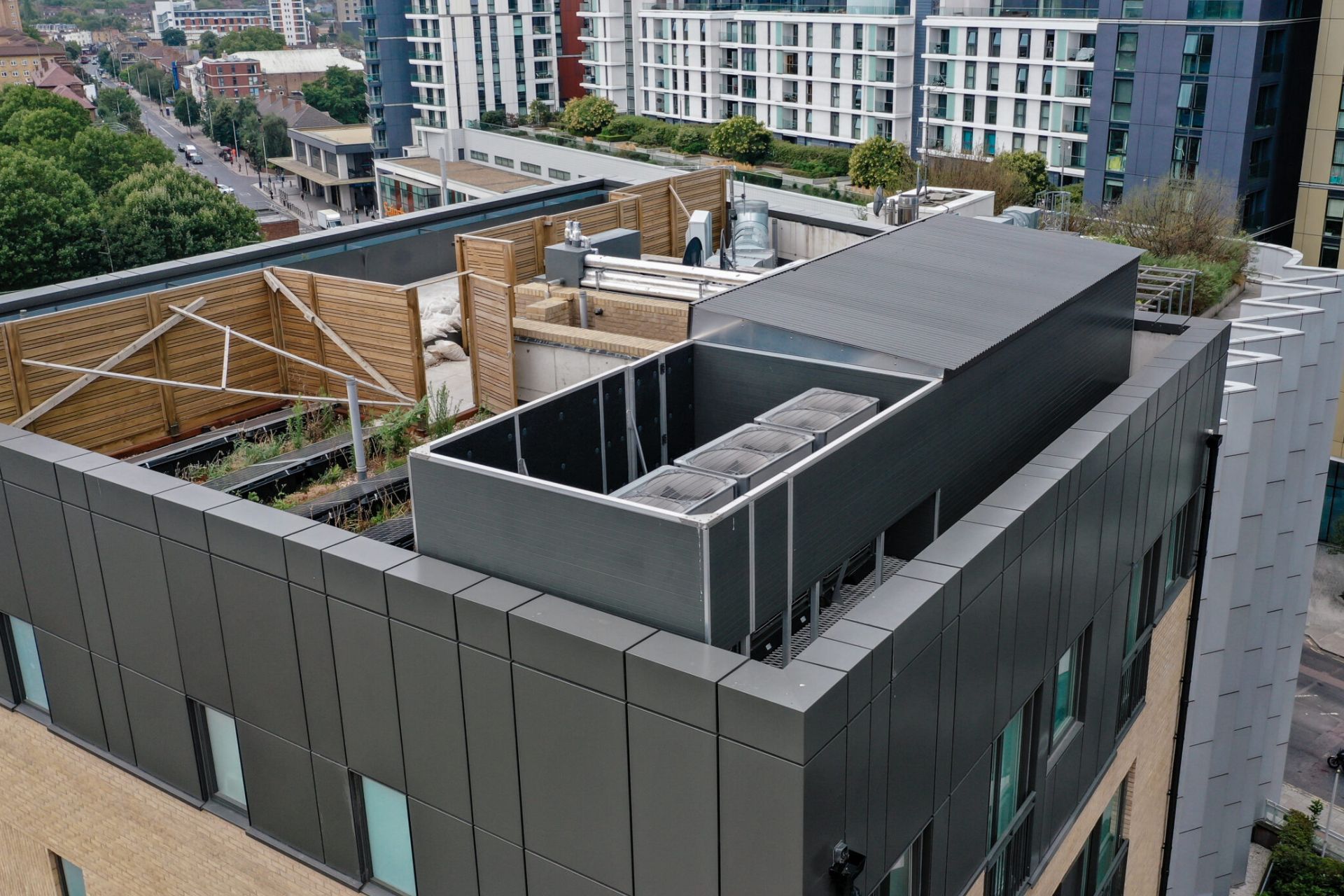
Acoustic Louvres vs Acoustic Enclosures for BS 4142 Compliance
When a BS 4142 assessment identifies that rooftop plant noise needs reducing, specifiers face a fundamental choice. Do you enclose the plant completely with solid acoustic panels? Do you use acoustic louvres that allow airflow? Or do you combine both?
The answer depends on the equipment, the required attenuation, and the ventilation demands of the plant. Getting this balance right is the difference between a specification that works and one that creates new problems.
What Do Acoustic Enclosures Do?
A full acoustic enclosure surrounds the plant equipment with solid panels that block sound transmission. The enclosure acts as a physical barrier between the noise source and the receptor.
Solid acoustic panels work through reflection, absorption, or both:
- Reflective panels like Soundshield (Rw 28dB) bounce sound energy back towards the source
- Absorptive panels like Peacemaker (NRC 1.0) trap sound energy within the panel material
- Combined systems like Acoustic+ (Rw 33dB, NRC 1.0) deliver both in a three-phase process
Acoustic enclosures provide the highest level of noise reduction because they create a continuous barrier with minimal gaps for sound to escape.
However, a fully sealed enclosure creates a problem for equipment that generates heat and requires airflow for cooling.
What Do Acoustic Louvres Do?
Acoustic louvres provide noise attenuation while maintaining airflow through the enclosure.
They use an engineered blade profile that forces sound waves through a controlled path, absorbing and reducing energy before it exits the system.
Peaceflow features:
- 150mm repeat pitch louvre profile
- Five performance variations
- Modular heights of 1000mm, 1200mm, and 1500mm
The trade-off is straightforward:
- Pros: Maintains airflow, essential for plant operation
- Cons: Lower acoustic performance compared to solid panels
Louvres are essential wherever ventilation is required for proper equipment function.
Acoustic Louvres vs Enclosures. When to Use Each Approach
The Combined Approach
In practice, most rooftop plant installations use a combination of both acoustic enclosures and louvres.
The most effective designs are not uniform. They are tailored elevation by elevation, matching the acoustic treatment to each face of the enclosure.
Example Specification
- North elevation (residential-facing):
Acoustic+ solid panels for maximum attenuation (Rw 33dB) - South elevation (commercial-facing):
Peaceflow acoustic louvres for ventilation with moderate attenuation - East and West elevations:
Soundshield reflective panels where airflow is not required - Internal:
Baffles to absorb reflected sound and prevent internal noise build-up
This approach ensures acoustic performance where it matters most while maintaining efficient plant operation.
Specifier Tip
Always review the acoustic consultant’s report on an elevation-by-elevation basis. Attenuation requirements will vary depending on the direction and proximity of each noise-sensitive receptor.
Designing each face independently provides the best balance of performance, airflow, and cost.
Why Modular Systems Make This Easier
Traditional steel enclosures often require bespoke fabrication when combining solid panels and louvre sections. This increases complexity and creates potential weak points for sound leakage.
Pre-engineered modular systems simplify the process.
Because Soundshield, Peacemaker, Acoustic+, Baffles, and Peaceflow integrate within the same framework:
- Switching panel types becomes a configuration choice rather than a redesign
- Installation is faster and more predictable
- Acoustic performance is more consistent
Modularity also future-proofs the installation. If requirements change, individual panels can be swapped or upgraded without replacing the entire enclosure.
Making the Right Call
The choice between acoustic louvres and acoustic enclosures is rarely binary.
The most effective specifications use both, tailored to:
- The BS 4142 assessment outcome
- Plant equipment layout
- Airflow and ventilation requirements
Configured Platforms works with specifiers and acoustic consultants to determine the optimal combination for each elevation, ensuring compliance and efficient performance.
Need help choosing the right acoustic solution for your project? Contact us today or check out our recent projects.