
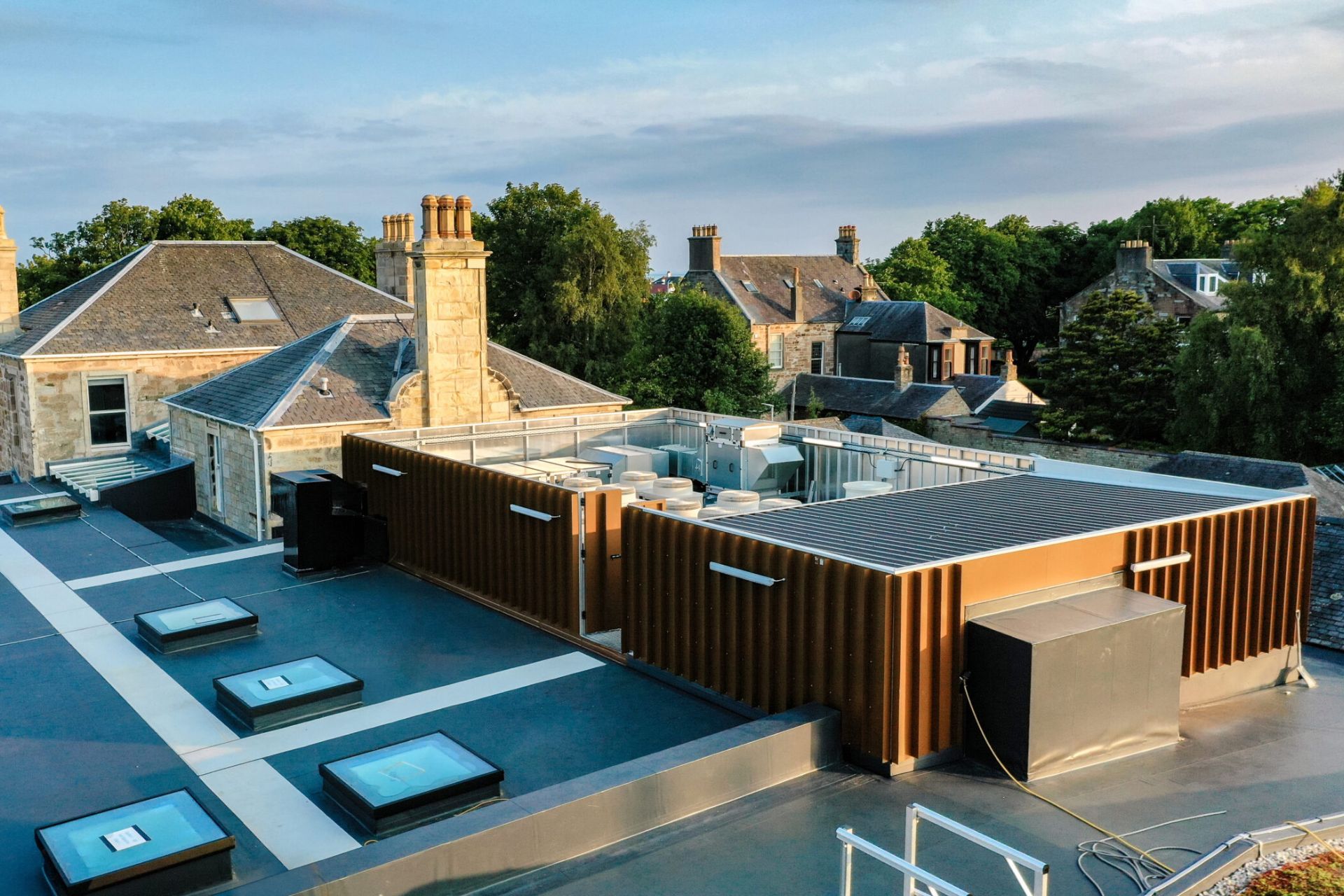
Every rooftop mechanical plant installation has a noise footprint. Chillers hum. Condensers cycle. Extract fans push air through ductwork. Individually, these sources may seem manageable. Together, they can produce sound levels that exceed what local planning authorities will accept at the nearest noise-sensitive receptor.
BS 4142:2014+A1:2019 is the standard that local authorities use to assess whether the noise footprint is acceptable. Understanding how it works is essential for any specifier or contractor involved in rooftop plant design.
What BS 4142 Actually Measures
BS 4142 compares two noise levels at the nearest noise-sensitive receptor (typically the closest residential window or garden).
The first is the background sound level. This is the ambient noise that exists at the receptor without the plant running. It is measured as an LA90 value, which represents the sound level exceeded for 90% of the measurement period.
The second is the rating level. This is the predicted noise level from the plant equipment, measured as an LAeq and then adjusted with character corrections. If the plant noise has a tonal quality, is impulsive, or is intermittent, the assessor adds penalty corrections that increase the rating level. These corrections reflect the fact that certain noise characteristics are more noticeable and more likely to generate complaints.
The assessment compares the two. The greater the difference between the rating level and the background sound level, the greater the likelihood of adverse impact.
How the Assessment Outcome Affects Your Project
The comparison produces a numerical difference that determines the planning outcome.
- Rating level at or below the background level means a low probability of adverse impact. The plant is likely to be acceptable without additional mitigation.
- Rating level up to 5dB above the background is where context matters. Depending on the setting, the local authority may accept it, require conditions, or refuse.
- Rating level 10dB or more above the background is a strong indication of significant adverse impact. Without mitigation, planning permission is unlikely to be granted.
The critical point for specifiers is that this assessment happens at the receptor, not at the plant. Sound attenuates with distance, but in urban environments with limited separation, even moderate plant noise can breach the threshold.
When Does BS 4142 Apply?
Most local planning authorities require a BS 4142 assessment for any new external mechanical plant installation. This includes rooftop chillers, condensers, air handling units, extract fans, combined heat and power (CHP) units, air source heat pumps, and generators.
The assessment period is one hour during daytime (07:00 to 23:00) and 15 minutes during night-time (23:00 to 07:00). Night-time criteria are typically more stringent because background levels are lower and receptor sensitivity is higher.
Key point for specifiers. If your project includes any rooftop mechanical plant within 50 metres of a residential or mixed-use building, assume that a BS 4142 assessment will be required and that acoustic mitigation is likely to be a planning condition.
How Does Acoustic Screening Help You Pass?
When a BS 4142 assessment identifies that plant noise will exceed the acceptable threshold, the most common mitigation is acoustic screening. The goal is to reduce the rating level at the receptor to a point where it meets or falls below the background.
Acoustic screening achieves this through three mechanisms.
- Reflective barriers block sound from escaping the plant enclosure. Systems like Soundshield (Rw 28dB) act as a physical barrier that prevents direct sound transmission.
- Absorptive panels trap and dissipate sound energy within the panel material. Systems like Peacemaker (NRC 1.0) convert acoustic energy into heat within their foam cell structure.
- Combined systems deliver the highest attenuation by using both absorption and reflection. Acoustic+ (Rw 33dB, NRC 1.0) works in three phases. Understanding the acoustic performance data behind these ratings helps you compare products with confidence.
Where the plant equipment needs airflow for cooling, acoustic louvres like Peaceflow provide noise attenuation while maintaining the free area required for ventilation.
Specifying Acoustic Screening for BS 4142 Compliance
The acoustic consultant will determine the required level of attenuation based on the BS 4142 assessment. Your role as specifier is to select a screening system that meets or exceeds that requirement while addressing the practical constraints of the installation.
Key specification considerations include the following.
- Required dB reduction. Match the Rw or insertion loss of the screening system to the attenuation target from the acoustic report.
- Airflow requirements. If the plant needs ventilation, at least one elevation will require acoustic louvres rather than solid panels.
- Structural loading. Lightweight screening systems (7.25 to 26 kg/m²) significantly reduce the load on the roof structure compared to traditional steel and concrete enclosures.
- Programme impact. Pre-engineered modular systems can be designed, manufactured, and installed in a fraction of the time required for bespoke steel fabrications.
- Retrofit capability. If acoustic requirements change post-installation (for example, if additional plant is added), the system should allow an upgrade without full replacement.
Getting It Right First Time
The most expensive acoustic screening is the one you have to install twice. Specifying correctly from the outset means engaging with the acoustic assessment early, understanding the planning conditions, and selecting a system that provides the required performance with margin.
Configured Platforms works directly with specifiers and acoustic consultants to match our acoustic screening systems to the BS 4142 assessment outcome. Our design team can review your acoustic report and recommend the right combination of Soundshield, Peacemaker, Acoustic+, Baffles, and Peaceflow for each elevation of your plant enclosure.
Need help specifying acoustic screening for a BS 4142 planning condition? Contact us today or view our recent projects to see how we can help.